
Shoulder Pain: What’s Really Causing It?

What is causing my shoulder pain?
A lot of physios will tell you that this question is like opening a can of worms and frankly sometimes it can be. Still, even if it's a broad overview, I am going to try to tackle this topic anyway.
Let's start off with the shoulder joint itself. I often describe to people that the ball and socket shoulder joint is like a golf ball on a golf tee. It has the ability to rotate in almost any direction but has a lower amount of stability compared to other joints. This means our muscles around the shoulder have to work slightly harder to keep it in safe and functional positions through movement.
Here is the issue with this. To accommodate for the increased range of movement, the shoulder recruits a high number of muscles, creating a bottle neck of sorts through the shoulder joint. This makes it more susceptible to irritation and generally means if something goes wrong, your body will let you know about it. Most commonly, the culprit causing your pain are a group of muscles called your rotator cuff muscles.
What causes rotator cuff related shoulder pain, and why does it develop?
There are multiple ways this sort of pain can start.
There are more obvious causes like falling onto your shoulder or fast acceleration movements like throwing, pushing or pulling. This can cause the rotator cuff muscles and tendons to stretch past a point that they can tolerate leading to a muscle strain (overstretch of a muscle) or tear.
However, this pain can come on gradually as well.
As we age (similar to our hair) our tendons start to fray and lose the plumpness and volume of youth. And because of the way our shoulders are built, this can put some people at risk of injury or inflammation in our rotator cuff tendons, even if there isn’t a clear mechanism of injury.
What are common symptoms of rotator cuff related pain?
A deep dull ache around your shoulder and upper arm - which may worsen with activity.
Restricted and painful overhead movement (e.g lifting your arm and washing your hair)
Unusual Weakness: difficulty with day to day lifting or carrying objects.
Unable to lie on your sore shoulder while sleeping or waking up to shoulder pain in the night from sleeping in an awkward position
How long do rotator cuff injuries take to heal?
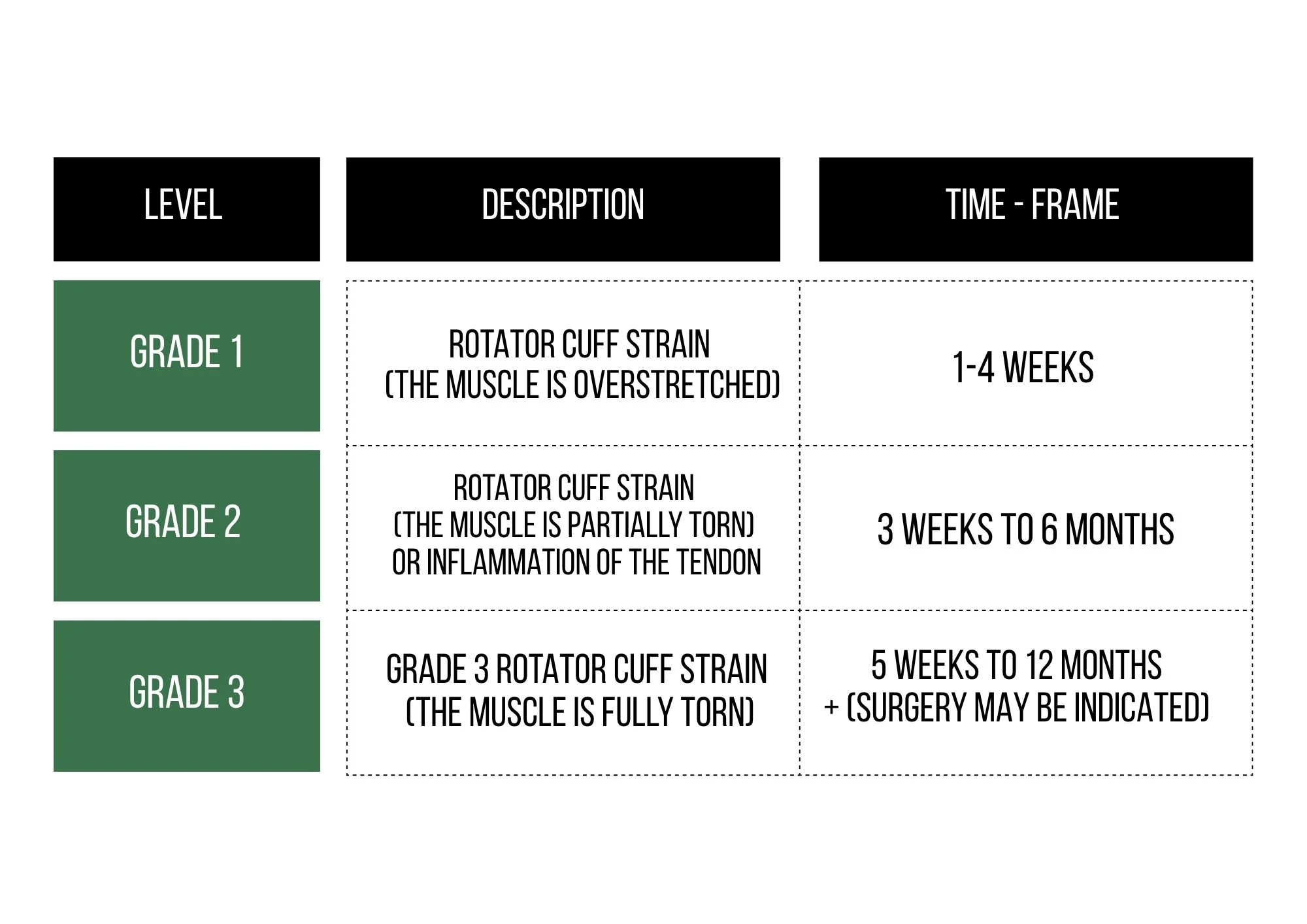
This depends on the severity of your shoulder injury and pre-existing factors but rotator cuff related shoulder pain generally falls into one of these categories assuming a surgical approach is not needed, but as a general guide:
What can I do when I injure my shoulder or start getting shoulder pain?
It might sound obvious but is a mistake most people make whether intentionally or by accident; you should try to avoid movements or activities that flare up your symptoms. I always ask my patients to imagine slamming their thumb into a car door and to keep hitting it every day over a week. The thumbs not going to get any better right?
The same principle applies to your shoulder pain. If you keep pushing your shoulder into the areas it doesn’t like, it won’t have the right environment to heal.
This doesn’t mean you shouldn’t move it though. You should keep moving your shoulder in a pain free range (even if it is tiny) to help promote good healing. The same principle applies to shoulder exercises. If it doesn’t hurt, it is helping you heal.
Go see a physio. The shoulder is a complex beast and will require proper and graded rehab. I recommend you go see your physio for advice and guidance on how to safely get your shoulder back to normal and prevent further injury
How can a physio help with shoulder pain?
Physio is key with rotator cuff related pain. Rotator cuff related pain can become a long term problem. Without proper rehab, your shoulder often loses range of motion and coordination. Deficits like these will often trap you in an endless cycle of either chronic shoulder pain or recurring injury.
It is not all doom and gloom though, your physio will create a tailored care pathway specific to your needs and goals. This will usually include (but not limited to):
Soft tissue release or dry needling
Taping
Education
The good news is that rotator cuff injuries are often funded under ACC. We at Rehab Co are registered with ACC, so if you have injured your shoulder, come in and see me (Jack - at the Christchurch clinic) or any of the team for an assessment to start your rehab process.
We have 7 convenient locations across Auckland, Wellington and Christchurch, making it easy to find a Rehab Co clinic near you.
Author: Physiotherapist, Jack Myles - Find him at the Rehab Co Christchurch clinic